What Is Erasure Poetry And How to Make Your Own When Words Fail You
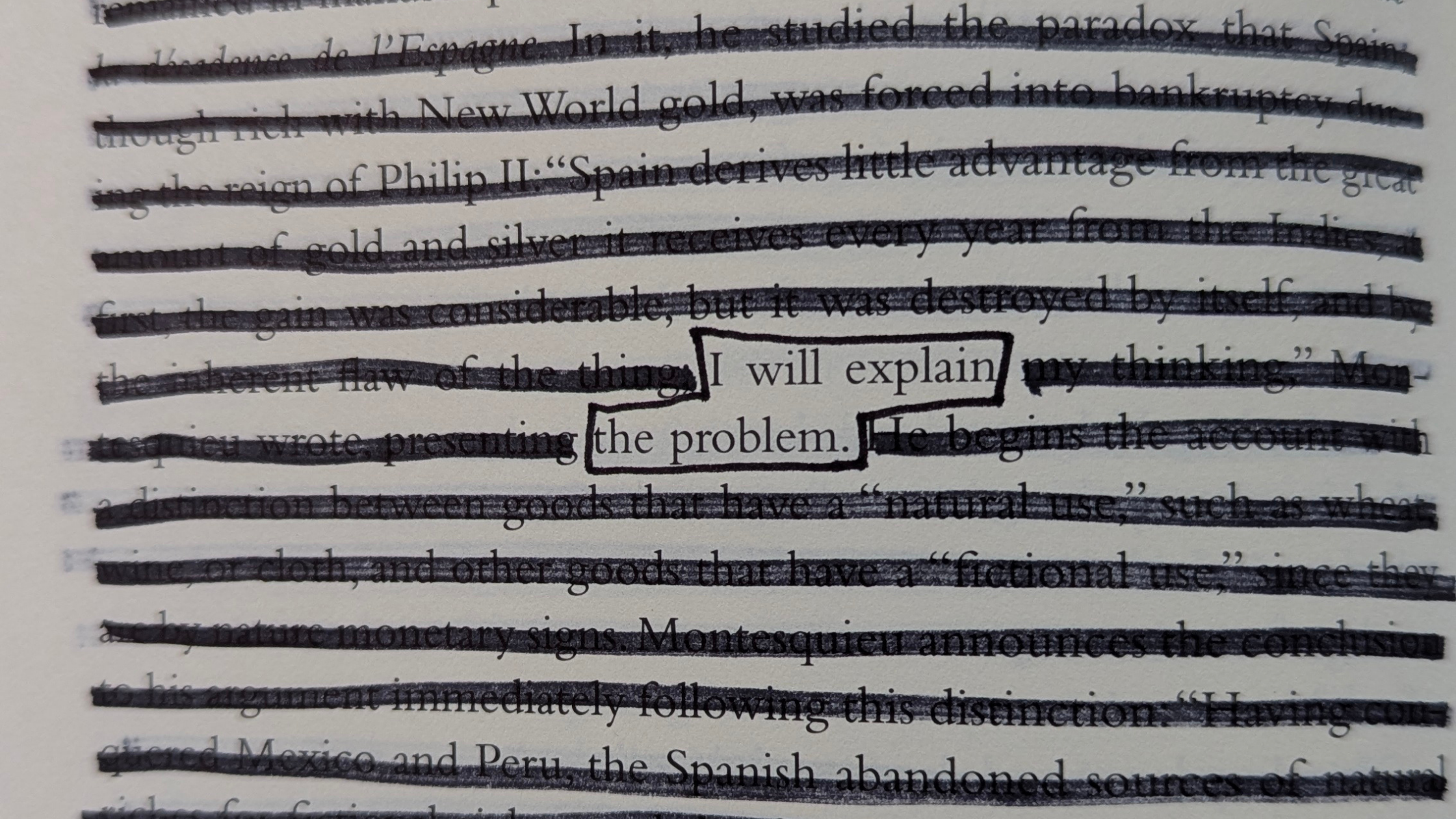
An erasure poem from Salt by Pierre Laszlo created by Ada Pembroke
Erasure poetry — the practice of finding hidden poems inside existing prose — saved my sanity during the Occupy Movement. I was living down the street from UC Berkeley, in my mid-20s, the perfect age to be grappling with a protest movement that hit me square between the eyes. I was working my way through graduate school, watching the clock tick down to graduation like the numbers on an action movie bomb. I'd gone to grad school because I had finished my English degree just in time for the financial crisis, and everyone told me to go to graduate school to wait it out.
By the time the Occupy movement started, it had become clear that there is no waiting out the collapse of the industry you trained for, and I was only delaying the inevitable agony of trying to find my way through the world with a mountain of student loan debt.
I was full of raw panic and other emotions that refused to sort themselves into words. I’d just spent two years reading and writing papers on over 50 books while writing a thesis and a novel and teaching writing classes at a hackerspace, and suddenly I could barely read a novel by Stephen King. As a person who’d spent six years finding the words for difficult things at 3 o’clock in the morning the night before a paper is due, not being able to find the words to articulate what I was feeling was a bit of an existential crisis.
I found my way through a long season of creative grief processing with erasure poetry, an unloved copy of Salt by Pierre Laszlo, and a big box of Sharpies. I learned to find myself in a text that had no room for me at all, a practice that became the hidden foundation of narrative astrology.
What Is Erasure Poetry — And Why You Might Need It Right Now
Ready to try it? Make your own erasure poem, share a photo or video, and tag it #RevealTheMyth
Erasure poetry is like sculpture for poets.
You take a prose text and remove everything from the page that isn’t the poem. Some poets make a real artistic practice out of it with paint or collage and call it “illuminating.”
I learned about erasure poetry from Rebecca Brown in grad school. Rebecca told us gleeful stories of writers who borrowed books from the library and subversively filled them with art. Erasure poetry is an obvious medium for political poetry, but her essay “Extreme Reading” in American Romances, told a different story, about how pulling the words out of someone else’s text taught her to find her voice again after her parents died. Just like me, her grief had left her unable to read. It felt, reading her story, like I was watching someone teaching their heart how to beat again or like a baby learning to walk on her parents’ feet.
In astrology, erasure poetry, destructive political art, and the grieving process are the domain of Pluto. God of the Underworld and Lord of Buried Treasure, Pluto is the activist mourning the last breaths of a collapsing civilization. He is the poet looking for their life in a moldy, forgotten book the way a mushroom in the forest finds life in death and decay, feeding the creatures of the forest, returning nourishment to the earth.
That was exactly how I felt crossing out thousands of lines of someone else’s prose to find the few words on a page that I could read. I had no idea what I was trying to say. I took each page one at a time. I drew a little box around the words I wanted to keep, and then I moved on to the next page. Sometimes, I discovered that there was a bit of connective tissue between one page and the next, so I went back and forth, massaging the little boxes into something slightly more narrative shaped. It felt like doing a crossword puzzle while silently singing the saddest song I'd ever heard.
When I was done erasing Salt, I had no idea what I had made. I read the book as if it had been written by someone else, and I was astounded to find that it was a story. It had characters. And a plot. It is about protest, the neglect of beauty, and the imprisonment of artists. It even had characters that I never intended to create: Altworks. Mono Poly.
I know (because I wrote it) that the story is secretly about helicopters hovering over my apartment terrorizing everyone in the neighborhood until 3 o’clock in the morning, and it’s about the time my best friend and I almost got swept up by riot police when we were trying to go to the farmer’s market. And it is about the almost weekly experience of running down the sidewalk away from screaming people who probably needed someone to give them some powerful anti-psychotics.
It was a story about Occupy that I had no idea I was telling, directed entirely by a part of my psyche that has no problem whatsoever directing my hands to do things that seem arbitrary. There are no helicopters in my story, but you can feel them in your chest like bass notes. All of the stuff that was too raw for words was stripped down to its bare essentials. No answers given, no words wasted.
As a narrative astrologer, I now recognize my early adventures with erasure poetry as an essential first step in my own journey away from the wreckage of the old publishing world and toward a more mystical kind of reading. Reading a chart is an awful lot like pulling a story about a protest movement out of a science book on salt. You take lines and angles and weird squiggles and find the story in it all.
I suggest getting started with erasure poetry on a day when your chest is full of wordless screams.
Find a book that you don’t mind destroying. (It’s essential that you don’t get too precious with it.) And start scanning the page for words that seem to glow.
When I was creating my first erasure book, I circled the words I was looking for and then went back through the whole book with a Sharpie and crossed out everything that wasn’t circled. Doing things that way allowed me to “edit” by circling new words and crossing others out before I sent the Sharpie on its mission of destruction. It was also deeply meditative at a time when I needed to do something completely mindless with my hands.
I’m currently working on a book that has something to do with deserts and time travel, apparently, and I’m not going to bother with the Sharpie routine. I want to illuminate this time, not destroy. Maybe I’ll even try drawing flowering vines in the margins like a Medieval artist.
Repetition is a device serious poets use. Don’t be afraid to circle the same word over and over again.
Don’t be afraid of anything.
And don’t expect anything you’re doing to make sense until you’re done–at the absolute earliest.
Dive Deeper with Astrology and Writing